Learning how to write CV references properly turns a small section into a quiet advantage, since a prepared referee backs you far better than one caught off guard.
What Is a Referee in a CV, and Why This Section Still Matters
So what is a referee in a CV, exactly? It’s someone, usually a former manager, supervisor, or senior colleague, who has agreed in advance to vouch for your work if an employer contacts them. This section still carries weight because it’s one of the few parts of a CV a hiring panel treats as evidence rather than your own claim about yourself. Anyone can write “collaborative” or “detail-oriented” on a CV. A referee saying the same thing, unprompted, lands differently. That’s exactly why the reference block deserves the same care as your work history, not a rushed line tacked on at the bottom.
List References Only When They’re Expected
In most industry applications, “references available on request” does the job, and printing full details just wastes space. Academic, clinical, and public-sector roles tend to work differently: they often ask for named referees up front, right there in the application. Read the call or job posting closely, and give exactly what’s requested, nothing more.
When referees are called for, three is the common number. That spread usually covers a supervisor, a collaborator, and a senior figure who can speak to how you carry yourself professionally, not just what you produced.
The Four Elements Every CV Reference Entry Needs
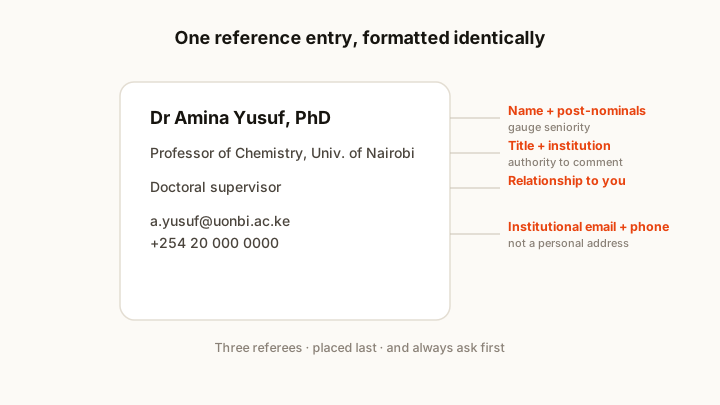
Format every entry the same way so the block reads as a set rather than a scramble. A solid CV reference includes:
- Full name and post-nominals, so the reader can gauge seniority at a glance.
- Title and institution, which shows why this person is qualified to comment on you.
- Relationship to you, stated in one short line, such as “line manager” or “doctoral supervisor.”
- Professional email and phone number, ideally an institutional address rather than a personal Gmail account.
Line these up in a single column with even spacing, and keep the section last on the page, after everything a reader will judge you on directly.
How to Write References in CV Format, Step by Step
Once you know a role expects named referees, work through it in order rather than dashing off names from memory.
- Shortlist two or three people who know your work from different angles.
- Ask each one directly, and share the job description and your current CV so their framing matches yours.
- Confirm their preferred title, contact details, and how they’d describe their relationship to you.
- Format all entries identically using the four elements above.
- Place the section at the very end of the document, after publications, projects, or work history.
- Re-check every email and phone number right before you submit, not weeks earlier.
Skipping step two is the mistake that causes the most damage. A referee who gets an unexpected call, with no context, often gives a vaguer or more hesitant answer than one who’s had five minutes to prepare.
Choosing the Right Referees for the Job
Picture a marketing coordinator candidate named Tom, applying for a role at a retail brand. He lists Grace Muthoni, Marketing Director at Sokoni Retail, as his former manager, and James Whitfield, Creative Lead at Bright Sky Media, as a client-side collaborator he worked with on a rebrand project. Together they cover two angles: how he performs under a manager’s direction, and how he handles external partners under deadline pressure.
That pairing works better than three references who all report the same story. Aim for people who can speak to distinct parts of your working life, not just repeat each other.
Common Mistakes That Undermine a Reference List
A weak entry often looks like this: “Mike, my old boss, mike99@gmail.com.” No title, no company, no phone number, and a personal email that suggests he wasn’t asked for anything more formal.
A stronger version: “Michael Grant, Operations Manager, Cedarwood Logistics. Former line manager (2022-2024). m.grant@cedarwoodlogistics.com, +44 7911 123456.”
Other common mistakes worth avoiding:
- Listing a referee who hasn’t agreed yet.
- Leaving an old employer’s contact details unchanged after they’ve left the company.
- Mixing formats across entries, so one has a title and another doesn’t.
- Including references when the posting never asked for them.
A Full Reference Entry You Can Copy and Adapt
Here’s a complete entry, ready to adapt with your own referee’s details:
Dr. Elena Vasquez, PhD Senior Lecturer, Department of Chemistry, University of Leeds Doctoral supervisor, 2021-2025 e.vasquez@leeds.ac.uk | +44 113 496 2200
Swap in your referee’s name, title, institution, and relationship, then repeat the same structure for each additional entry. Keeping the format identical across all three is what makes the section look deliberate rather than assembled in a hurry.
Tailoring References to Academic, Clinical, and Public-Sector Roles
Because named referees usually appear on academic or formal CVs, placement relative to the rest of the document matters. The academic CV guide walks through where the reference section sits alongside publications and service work, which differs from a standard industry layout.
Clinical and public-sector applications often specify how many referees are required and sometimes even who qualifies, such as a current or immediate past supervisor. Follow those rules exactly rather than defaulting to the standard three.
Tools to Polish the Rest of Your CV
Once your reference section is set, run the full document through the resume checker to catch formatting issues before a human reviewer does. Build or adjust the overall layout in the CV maker, and if you’re unsure where references fit relative to everything else, how to write a CV covers the full structure section by section.
Make Your References Work as Hard as the Rest of Your CV
Knowing how to write CV references well is a small piece of the application, but it’s one that either backs up everything you’ve claimed or quietly undercuts it. Ask early, format consistently, and only include the section when it’s actually requested. Get that right, and your referees become an asset instead of a loose end. When you’re ready to put the rest of the document together, the CV maker can help you build a layout that holds up just as well.