An academic CV is the complete scholarly record graduate committees expect, not a trimmed resume. Structure it right, and your research finally gets the reading it deserves.
What Is an Academic CV, and How Is It Different from a Resume?
A resume is a marketing document. One to two pages, tailored to a job posting, written to be skimmed in under a minute. An academic CV is something else entirely: a comprehensive account of your scholarly life, built for faculty, postdoctoral, fellowship, and research positions.
It grows with your career instead of shrinking to fit a page. A committee reading it wants your full publication record, your funding history, your teaching load, and your service commitments, not a curated highlight reel. Leave something out and reviewers may assume it doesn’t exist.
If you move between academia and industry, you’ll likely need both documents, kept as separate versions of one underlying record. The resume compresses; the CV documents. Confusing the two conventions is one of the fastest ways to look like an outsider to a hiring committee, so it’s worth treating them as genuinely different genres rather than two lengths of the same thing.
The Sections You Need, in Order
Order signals priority to anyone scanning quickly, so don’t treat section placement as an afterthought. A widely accepted structure for a research-focused CV runs like this:
- Contact information and credentials - name, degrees, current position. Format credentials cleanly (Jane Okoro, PhD) and keep the header uncluttered.
- Education - reverse-chronological, with institution, dates, and dissertation or thesis title plus advisor.
- Research experience - positions, labs, and what you actually investigated.
- Publications - usually the centerpiece (more on this below).
- Grants and funding - amounts, agencies, and your specific role.
- Teaching experience - courses, levels, institutions.
- Presentations, talks, and posters.
- Awards and honors.
- Service, memberships, and references - see listing professional affiliations for grade, office, and ordering conventions, and formatting CV references for the referee block itself.
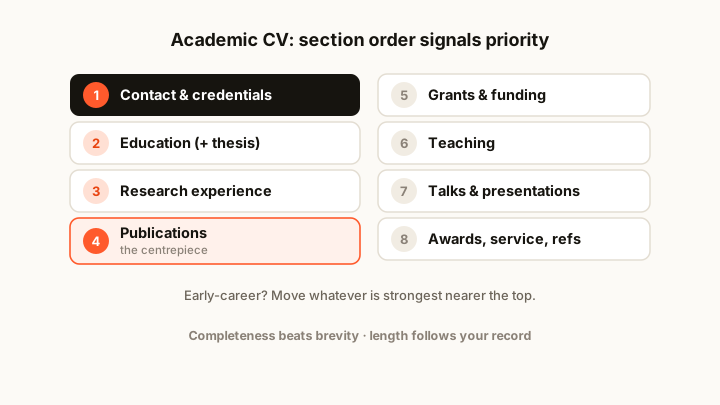
Early in your career, move whatever is strongest closer to the top. A PhD candidate with a thin publication list but a strong teaching record can lead with teaching right after education, and no committee will fault them for it.
Academic CV Format: Length, Structure, and the Publications List
Forget the one-page rule. It doesn’t apply here, and trying to force your record onto a single page usually just signals you don’t know the conventions. The right academic CV format is as long as it needs to be to represent your work completely, and that length changes a lot by career stage:
| Career stage | Typical length |
|---|---|
| Undergraduate applying to grad school | 1-2 pages |
| PhD candidate | 2-4 pages |
| Postdoc or early faculty | 4-6 pages |
| Senior researcher | 8-10+ pages |
What committees dislike isn’t length, it’s padding: repeated entries, vague descriptions, anything that reads as filler. Be complete, be specific, and cut nothing real.
Within that structure, the publications list is what gets read closest, so treat it with care. Use a consistent citation style for your field and stick to it exactly. Group entries by type, peer-reviewed journal articles first, then book chapters, conference papers, preprints, and patents. Bold or underline your own name in each citation so a reader finds your contribution instantly, and mark status honestly: published, in press, under review, in preparation. Never inflate a status to make the list look stronger than it is.
Listing patents alongside publications has its own conventions; if that applies to you, see how to list publications and patents on your CV.
Building Your First Academic CV as an Undergraduate
If you’re an undergraduate heading toward graduate school, your undergraduate CV will look thinner than a PhD candidate’s, and that’s expected, not a flaw. The same section order applies, but a few things shift. Coursework relevant to your intended field can stand in where research experience is sparse. A senior thesis, even an unfinished one, deserves its own line with a working title and advisor.
Research assistantships often get underwritten because students assume the work sounds too small to list. It doesn’t. Compare these two versions of the same line:
Before: “Helped with a research project in the biology lab.”
After: “Research assistant, Dr. Patel’s lab, University of Edinburgh (2025-present): coded behavioral data for a 60-subject zebrafish study; co-authored a poster presented at the departmental symposium.”
The second version is specific about scope, method, and outcome, and it reads like a real contribution because it is one. When you build your undergraduate curriculum vitae, include any conference attendance, lab techniques you’re competent in, and relevant coursework with grades if they’re strong. Skip sections you genuinely have nothing for rather than padding them with generic filler; an honest three-page CV beats a stretched five-page one every time.
Action Verbs and Specificity: Making Every Entry Count
Even in a formal document, weak phrasing costs you. Lead each entry with a precise verb, designed, secured, supervised, presented, coded, and attach the specifics that make the claim verifiable.
“Studied community health outcomes” tells a reviewer almost nothing. “Designed and administered a 14-month survey of 340 households on maternal health access, funded by a $22,000 departmental grant” tells them exactly what you did, at what scale, and who backed it. That’s the difference between an entry that gets skimmed past and one that gets remembered.
The same logic applies to teaching and service entries. “Taught undergraduate courses” is forgettable. “Designed and delivered a new 200-level statistics course, restructuring the syllabus after enrollment doubled to 85 students” gives a search committee something concrete to picture. Specificity isn’t about padding length, it’s about giving reviewers a reason to trust the claim.
Common Mistakes That Cost You Interviews
A few errors show up again and again, and most are easy to fix once you know to look for them:
- Trying to force it onto one page. Compressing a genuine record makes it look thin, not tight.
- Inconsistent citation formatting. Switching styles mid-list signals carelessness with the exact kind of detail academia cares about.
- Vague entries with no numbers. “Assisted with research” versus a specific method, sample size, and outcome.
- Burying strong material. A major grant listed halfway down page four does you no favors.
- Letting it go stale. A CV last updated two years ago is missing a year’s worth of evidence of your growth.
- Overstating publication status. Listing something as “in press” when it’s still under review erodes trust fast if a reviewer checks.
None of these are hard to avoid once you’re structuring the document deliberately instead of assembling it under deadline pressure.
An Academic CV Template You Can Copy
Here’s a short, realistic excerpt you can use as a starting academic CV template for the education and publications sections, adjusted to your own details.
Amara Chen, PhD Candidate Department of Environmental Science, University of Toronto
Education PhD, Environmental Science, University of Toronto (2023-present) Dissertation: “Microplastic Transport in Freshwater Sediment Systems,” advised by Dr. Wei Fenwick
BSc, Environmental Science, McGill University (2019-2023), First Class Honours
Publications Chen, A., & Fenwick, W. (2026). Sediment-bound microplastic accumulation in urban watersheds. Journal of Environmental Monitoring, 41(2), 118-134.
Chen, A. (2025). Sampling protocols for microplastic detection in low-flow rivers. Conference paper, International Water Research Symposium.
Grants Vanier Canada Graduate Scholarship, $50,000/year (2024-2027), sole recipient.
Swap in your own institution, advisor, and figures, but keep the pattern: full citation detail, honest status, and a grant line that states the amount and your role plainly.
Tailoring for Specific Applications
Your base academic CV is your master document. Specific applications need specific emphasis, and each has its own conventions worth getting right:
- Postdoctoral applications foreground your dissertation and immediate research fit - see formatting a CV for postdoc applications.
- Clinical research roles weight protocols, trials, and regulatory work - see building a CV for clinical research.
- Senior and faculty roles lead with funding, supervision, and impact - see the senior researcher CV masterclass.
- Creative and practice-based fields showcase a portfolio of published or produced work - see the creative-writing CV.
Keep the master version complete and cut from copies for each application, not the other way around. Trying to rebuild from a trimmed-down version means you’re always reconstructing detail you already had.
Keeping It Current
An academic CV is never really finished. Update it the moment something happens, a paper accepted, a talk given, a grant awarded, rather than trying to reconstruct a year of activity under deadline pressure. Memory fades faster than you’d expect, and exact dates and figures are hard to recover months later.
A quarterly ten-minute pass keeps it accurate. That’s the same discipline that keeps any CV job-ready (see how to keep your CV updated), and it matters even more here, because your record is effectively your career on paper.
The Bottom Line
An academic CV rewards completeness, honesty, and clean structure over cleverness or polish. Build one thorough master record, keep it current, and tailor a focused version for each application rather than starting over each time.
When you’re ready to put this into practice, Kazifi’s CV maker keeps your master academic record and each tailored version in one place, so applying to the next fellowship is an edit, not a rebuild.