Knowing how to indicate relocation readiness on a resume settles an overseas employer’s biggest doubt before they read your experience, and the rest of your application gets judged on skill instead of geography.
What Relocation Readiness Actually Means
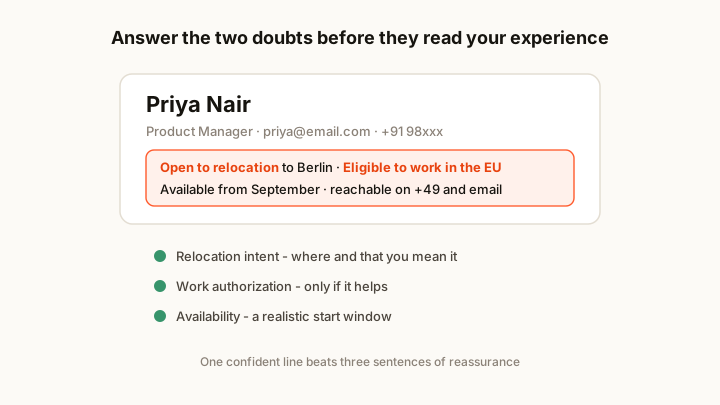
Saying “willing to relocate” at the bottom of a resume used to be enough. It isn’t anymore. To truly indicate relocation readiness on a resume, you need more than a tagline: a specific destination, a work authorization status, and a date you can start. Vague willingness reads as hesitation to a recruiter scanning fifty applications, while specifics read as someone who has already made the decision. The goal is to answer the move question before it gets asked.
Why Employers Hesitate on Long-Distance Candidates
An employer weighing a local candidate against someone abroad is quietly doing risk math. Will the paperwork take months? Will the candidate back out once they see rent prices? Will interviews stretch across time zones for weeks? None of these worries are personal, they are just friction, and friction makes hiring managers default to the safer, closer option. A resume that answers authorization and timing up front removes most of that friction in a few words.
The Three Signals Every Relocation-Ready Resume Sends
Three pieces of information do almost all the work: your intent, your legal status, and your timeline. Put together, they might read like this near your header:
Open to relocation to Lisbon, Portugal | EU work permit, no sponsorship required | Available from November 1
Each piece answers a distinct question, so leaving one out just shifts the guesswork back onto the employer. If your authorization situation is more layered, the wording matters more than most people expect. That’s a deep enough topic on its own, and it’s covered in navigating visa sponsorship language.
Where to Place the Relocation Line for Visibility
Burying this information in your cover letter is a common misstep, mostly because recruiters often skim the resume first and only open the cover letter for shortlisted names. Put the relocation line in your header or the first line of your summary, not the last bullet of your work history. A short, separated format works well:
- Relocation: “Open to relocation to Toronto, Canada”
- Authorization: named only if it helps your case
- Availability: a realistic date, not “immediately” unless it’s true
- Contact: an email and a phone number with the correct country code
Stating Your Notice Period and Availability Window
Separate from relocation and sponsorship, employers also want a plain answer on timing. This is where cv availability language belongs, stated as a concrete window rather than “flexible” or “TBD.” Consider Wanjiru, a marketing coordinator in Lisbon whose contract requires 30 days’ notice. Her resume header reads: “Availability: one month’s notice, per current contract terms.” A hiring manager in Amsterdam reading that line knows exactly when she can start without emailing to ask. Two weeks is standard in parts of the US, while a month is common across much of Europe, the UK, and East Africa, so state your actual figure rather than assuming the reader shares your local norm.
Localizing the Document Without Changing the Facts
Your achievements do not change when you relocate, but the packaging should still meet the destination. Match the country’s length norm and its English spelling, and add brief context for anything a foreign reviewer will not recognize, such as naming the country beside a city or glossing a local employer in a few words. This is tailoring, not fabrication; every fact stays exactly as it was. The fuller checklist, covering paper size, date formats, and photo norms, is in the international resume guide.
Common Mistakes That Undercut Relocation Readiness
A few habits quietly work against candidates who are otherwise strong on paper:
- Writing “willing to relocate” with no city, country, or date attached.
- Waiting until the interview to mention a sponsorship need, which can derail trust that late in the process.
- Leaving the home country’s phone format untouched, missing the country code entirely.
- Listing availability as “immediately” when the real notice period is a month.
- Copying a home-market resume format without adjusting length or spelling conventions.
Any one of these can cost a second look, and together they compound.
Before and After: Turning Vague Interest Into a Confident Line
Compare two ways of saying the same thing. Before: “I’ve always dreamed of working abroad and would consider relocating for the right opportunity.” After: “Ready for relocation to Berlin, Germany; EU work authorization; available from September 15.” The first leaks uncertainty and asks the reader to do the work of figuring out if you’re serious. The second reads like someone who already booked the decision and just needs the offer.
Tailoring the Message to Each Application
The same candidate applying to a Berlin fintech and a Toronto agency in the same week should not send an identical relocation line to both.
| Element | Berlin application | Toronto application |
|---|---|---|
| Authorization | EU passport, no sponsorship required | Requires employer-sponsored work permit |
| Availability | Available from September 15 | Available 6 to 8 weeks after offer |
| Local detail | City and country both named | Province noted alongside city |
Adjust each version with the tailor-per-role guide, confirm the file still parses correctly in a foreign applicant tracking system with the ATS checker, and read international CV standards for expats for the broader context behind these choices.
Make the Decision Easy for the Employer
A resume that states intent, authorization, and availability in three clear lines removes the guesswork that stalls overseas applications, letting your actual experience get the fair read it deserves. Build your localized, relocation-ready version in the resume builder and let the header do that work for you before a single bullet point comes into view.