An executive CV has to prove judgment, not just experience, since boards and search committees scan for scale and outcomes in seconds. Format it right, and it opens doors a generic résumé never could.
What Makes an Executive CV Different
A junior CV lists what someone did. An executive CV shows what someone decided, and what happened because of it. That distinction sounds small, but it changes almost every line on the page.
At this level, a reader wants three things fast: the size of the operation you ran, the calls you made under pressure, and the measurable shift that followed. Duties tell them what your job was. Outcomes tell them whether you were good at it. A CV built around task lists, however accomplished the person behind it, reads as if it were written by someone earlier in their career, which undercuts the very seniority it’s meant to prove.
So the format has to work harder than it does for other roles. It needs to compress twenty years of complexity into two pages without losing the signal a committee is hunting for.
Why the Format Matters to Search Committees
Most executive search consultants and board members give an initial CV scan somewhere between thirty seconds and two minutes before deciding whether to read further. That is not much time to prove you have run something at scale.
If the scope and the results are buried in paragraph six, they may never get found. A reader skimming for “P&L size,” “team size,” or “what changed” needs those answers near the top, not deduced from a wall of prose.
This is also why generic openings hurt more at senior level than anywhere else. A line like “results-driven leader with a proven track record” tells a committee nothing they couldn’t guess. It wastes the exact real estate where you should be stating scale and domain in plain numbers. Committees aren’t being harsh when they pass on CVs like this; they’re simply unable to find what they came looking for.
The Core Elements Every Executive CV Needs
Every strong executive CV, regardless of sector, tends to include the same handful of building blocks:
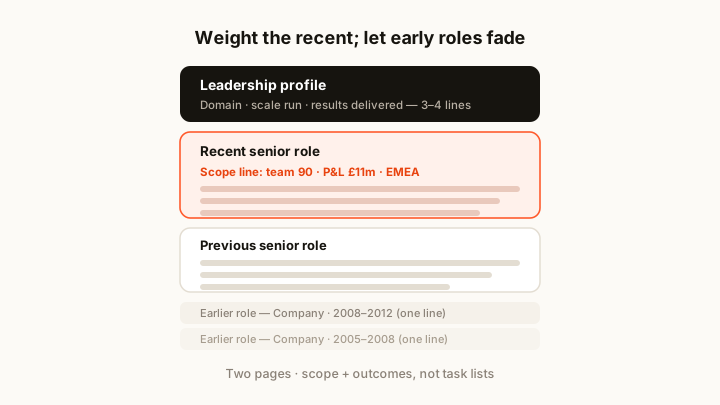
- A leadership profile at the top, three to four lines stating domain, scale, and the kind of results you deliver.
- A scope line under each senior role, naming team size, budget, region, or remit.
- Outcome bullets that carry numbers and timeframes, not just verbs.
- Governance signals, such as committees chaired, acquisitions led, or restructures completed.
- Compressed early career, listed by title, company, and dates only.
None of these are optional dressing. Leave one out and a reader has to guess at something they should simply be told.
How to Structure and Format the Page
Below the profile, structure each role as scope first, then outcomes. State what you were responsible for in a single line, then let three or four achievement bullets do the heavy lifting.
Compare two openings for the same person. “Experienced operations leader with strong results across multiple industries” could describe almost anyone. “Chief Operating Officer who cut fulfillment costs 22% while scaling a distribution network from four warehouses to eleven in three years” tells you the domain, the scale, and the result in one breath. The second version is what actually gets read twice.
Two pages remains the sensible target, stretching to three only for a genuinely long executive career. Detail the last ten to fifteen years in full; everything earlier can fade into a short list. The broader layout rules still apply here too: one clean column, consistent headings, and enough white space that the page doesn’t feel like a report. See the CV format and design guide for those fundamentals.
Position Through Strategy, Not a Duty List
Reverse chronological order still works at executive level, but weighting matters more than order. Give your current and most recent senior role the bulk of the page. Let a role from a decade ago earn two lines, not ten.
Pick three or four signature achievements per role rather than trying to document everything you touched. A committee remembers a specific, sharp result far better than a long inventory of responsibilities. Choose the moments that show range: a turnaround, a market entry, a cost structure you rebuilt, a team you grew from scratch.
And don’t be afraid to leave things out. What you choose not to include says almost as much about your judgment as what you keep.
Common Mistakes That Undercut Senior Candidates
A finance director once sent out a CV listing sixteen bullet points under her most recent role, mostly duties: “responsible for month-end close,” “oversaw audit relationships,” “managed treasury function.” Technically accurate. Completely forgettable. After trimming it to five outcome-driven lines with real numbers, she started getting callbacks within two weeks.
Watch for these common traps:
- Shrinking font size to squeeze a career onto one page instead of cutting content.
- Opening with an objective statement rather than a profile that states scale.
- Listing responsibilities without a single measurable result attached.
- Treating early career roles with the same detail as recent ones.
- Using jargon specific to one company that a search committee won’t recognize.
Any one of these can flatten an otherwise strong career on paper.
Board and Governance CVs Are a Different Document
A board CV is not simply an operating executive CV with a shorter job history. It exists to answer a different question: not “can this person run something,” but “can this person oversee, question, and guide people who run something.”
That means governance experience needs its own space: committees chaired, fiduciary oversight, risk or audit exposure, other directorships held. A useful scaffold for the opening line looks like this:
“[Independent director / committee chair] with [X] years leading [sector] organizations through [type of transformation], bringing [specific expertise] to boards overseeing [scale, e.g. revenue or assets].”
Fill in your own scope, and the line does real work instead of sitting there as decoration.
Adapting the Same Principles for HR and Customer-Service Leadership
The scope-and-outcome logic holds even outside general management. Someone searching for a human resource resume writer or a customer service resume writer is usually after the same thing: help translating people-leadership or service-leadership work into board-ready language.
| Track | Weak line | Strong line |
|---|---|---|
| HR leadership | ”Managed HR function for the company" | "Led a 40-person HR team through a merger, cutting voluntary turnover from 24% to 11% in eighteen months” |
| Customer service leadership | ”Responsible for customer support operations" | "Rebuilt a 60-agent support org, lifting CSAT from 71 to 89 while reducing average handle time 30%” |
Same structure, different domain. The scope line still names the size of the operation, and the outcome bullet still carries a number and a timeframe.
Tools and Resources to Build the Document
Drafting scope and outcome lines from scratch is the slowest part of this process, and it’s where most CVs stall. The bullet point writer helps turn a vague responsibility into a measurable achievement line.
Once the content is drafted, build it on an executive template designed for this altitude rather than a general-purpose one. Sharpen the profile section with the resume summary generator, and if none of the executive options fit your sector, the wider template gallery has formats that carry authority without unnecessary decoration.
Conclusion
A strong executive CV does one job above all others: it lets a reader see your judgment in the first thirty seconds, not just your job history. Get the scope lines right, let the outcomes carry the weight, and even a long, varied career reads clearly on two pages.
Start with the profile, draft the outcome bullets next, and build the layout last. Try the tools above and see how quickly a scattered career history turns into a document a committee actually wants to keep reading.