A career change CV has one job: prove you’re already becoming someone new, not just leaving someone old behind. Get that right and a hiring manager stops seeing a mismatch and starts seeing a plan.
What a Career Change CV Actually Has to Do
Most CVs are a record. A career change CV is an argument. It has to convince someone reading fast, often in under a minute, that your last job and your next job are connected by more than ambition.
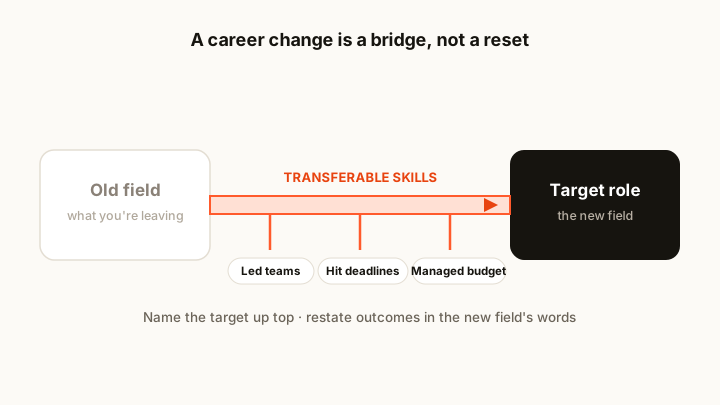
That argument rests on evidence, not enthusiasm. Recruiters are not hiring your old title. They are hiring the outcomes you can repeat in a new setting, whether that’s managing a budget, leading a team through a deadline, or solving a recurring operational problem. Your task is to surface those outcomes before the reader ever reaches your job history and starts making assumptions about what a “warehouse supervisor” or “high school teacher” can or can’t do.
This is why a straight chronological CV, the kind that works fine for someone staying in their lane, often fails a pivot. It buries the relevant parts under a job title that signals the wrong industry. A cv for career change situation needs a different structure, one that leads with direction and lets the history support it rather than define it.
Why Recruiters Reject Pivots Before Reading Your Experience
A recruiter scanning fifty applications for one role is pattern-matching, not reading closely. If your top third doesn’t answer “why is this person applying,” the instinct is to move on. That’s not unfair, it’s just triage under time pressure.
The problem compounds because your old job titles carry baggage the reader hasn’t asked you to explain yet. A “retail manager” applying for a “data analyst” role reads as random unless something on the page tells the reader otherwise fast. Silence gets filled with the least generous explanation: wrong fit, wrong experience, next.
This is also where software gets blamed for something structural. Many applicant tracking systems will pass a career-changer through just fine. What actually kills the application is a summary-free CV where a human reader can’t find the thread in the time they’ve allotted. Fix the thread first, and the system stops mattering as much.
The Elements Every Career Transition CV Needs
A strong career transition cv shares a handful of ingredients regardless of the industries involved. Missing any one of them tends to widen the gap a reader has to bridge on your behalf.
- A summary that names the target role. Not a vague “results-driven professional” line, an actual statement of where you’re headed.
- Two or three transferable strengths, stated early, that the rest of the CV will back up with proof.
- Evidence of movement, such as a certificate, course, or side project that shows the change is already underway.
- New-field vocabulary, replacing jargon from your old industry that means nothing to this reader.
- A brief, honest explanation of the pivot, even one sentence, so the reader isn’t left guessing.
None of these require years of new-field experience you don’t have yet. They require organizing what you do have so it reads as preparation rather than a detour.
Format and Structure: Building the Page in the Right Order
Order matters more on a pivot CV than almost anywhere else. Put your summary and target role at the top, always. Underneath it, list two or three transferable achievements as short, punchy bullets before you get into a full work history.
Only after that should the chronological roles appear, and even there, lead each bullet with the outcome rather than the old-industry task. A logistics coordinator’s bullet shouldn’t open with “managed inbound freight schedules.” It should open with “cut delivery delays by 18% by redesigning a scheduling system,” because that outcome reads the same in almost any industry.
Keep the whole document to one page if you have under ten years of experience, two if you have more. A pivot CV that runs long usually does so because it’s still trying to justify the old career instead of building the case for the new one. Trim ruthlessly toward the target, not toward completeness.
Turning Old Titles into Transferable Skills Resume Language
This is the actual craft of a transferable skills resume: translation, not invention. The work you did was real. What changes is the vocabulary you use to describe it, so a hiring manager in the new field recognizes it as relevant on first read.
Take a nurse moving into pharmaceutical sales. “Managed patient care plans for a 30-bed unit” becomes “built and executed individualized plans under time pressure, coordinating across a team of specialists,” which reads instantly as relationship management and cross-functional coordination. Same work. Different frame.
Do this line by line. Ask what a hiring manager in the target field would actually recognize as valuable, and strip anything that only makes sense inside your old industry’s shorthand. A finance term that impresses a CFO can be meaningless to a marketing director reading the same resume.
Common Mistakes That Sink a Changing Careers Resume
Even strong candidates undercut themselves with a few repeatable errors. A changing careers resume usually fails for one of these reasons rather than a lack of relevant experience.
- Leading with the old job title instead of the target role, so the reader’s first impression is the wrong industry.
- Listing duties instead of outcomes, which hides the transferable value inside task-level detail nobody outside your old field will parse.
- Skipping the summary entirely, assuming the CV will speak for itself. It rarely does, especially under a fast read.
- Over-explaining the pivot in a way that reads defensive rather than deliberate. One clear sentence beats a paragraph of justification.
- Ignoring keyword mismatch, keeping old-industry terms that make it harder for the applicant tracking system to read you as a match for the new one.
Most of these are fixable in an afternoon of editing. None require new experience, just sharper framing of what you already have.
A Worked Example: From Retail Store Manager to UX Researcher
Concrete beats abstract, so here’s a full example you can adapt. Priya Menon spent seven years as a retail store manager before deciding to move into UX research, a jump that looks wide on paper.
Her summary now reads: “Retail operations manager transitioning into UX research, with seven years reading customer behavior on the floor, running staff feedback sessions, and translating patterns into store-layout changes that lifted conversion 12%. Currently completing a UX research certificate and shadowing usability studies part-time.”
Below that, three bullets: “Ran over 200 informal customer interviews a year, identifying friction points that shaped store redesigns,” “Facilitated weekly staff feedback sessions, synthesizing input into actionable operational changes,” and “Analyzed foot-traffic and sales data to test layout hypotheses, a research pattern directly applicable to usability testing.” Only then does her chronological history appear, each bullet reframed the same way. The pivot reads as a natural extension of skills she’s used for years, not a leap of faith.
Tailoring Your CV and Cover Letter Together
A career change CV shows what transfers. The cover letter is where you explain why you’re moving, turning an apparent mismatch into a deliberate choice. This is genuinely one of the few situations where a cover letter earns its place rather than repeating the CV.
You don’t need to hide the pivot in either document. A brief, plain explanation, backed by a course finished or a project shipped in the new field, reassures a reader far more than a CV that pretends the old career never happened. If your transition also involved time away from work, handle that the same way: briefly and directly (see how to describe a career gap).
The wider strategy behind a successful pivot, transferable skills, bridge roles, and networking into a new field, is worth reading in full if you’re early in the decision: how to change careers.
Tools and Resources to Build Your Career Transition CV
You don’t have to build this from a blank page. Start by reframing your history with the resume summary generator, which helps you draft the target-first summary this whole approach depends on. Then rebuild the rest of the document in the resume builder.
From there, two more resources sharpen the details. The tailor-per-role guide shows how to point one CV at a specific job posting instead of a generic version of the new field. And the action verbs post helps your old work read in the vocabulary of the new one, which is often the difference between a bullet that lands and one that gets skimmed past.
The Case You’re Building
A career change CV isn’t a confession that you’re starting over. It’s proof that you’ve already started, and that the reader is meeting you partway through a transition, not at the beginning of one. Lead with the target, back it with transferable evidence, and let the rest of the page do quieter supporting work.
Get the structure right once and you can reuse it for every application in this new direction, adjusting only the details that change role to role. If you want a faster start, the resume builder above will carry the heavy lifting so you can focus on the story only you can tell.